How It WorksArchitectureDetectionIntelligenceSecurity

A fraud detection platform for financial transactions

Five layers of defense.All in under fifty milliseconds.

Real-time fraud detection that checks every transaction as it happens. We combine straightforward rules with powerful AI models to deliver a single, clear decision in milliseconds. 
< 50ms
Scoring latency
5
Security layers
3
Detection models in ensemble
POST /v1/score
Incoming transactiontx_8821a4f
Rules Engine
hard rules
pass
Detection Ensemble
3 models
pass
Decision Engine
verdict
challenge
Verdict: ChallengeOTP required
Total latency42ms
The Pipeline

One transaction. Five defensive layers.

Every transaction is filtered through a strict deterministic Rules Engine, evaluated across three distinct detection models, and finalized by a Decision Engine. An automated Action Layer then executes the protective response.

01

Rules Engine

Straightforward checks that run first. Wrong country? Amount too high? Too many attempts in a short time? Device seen on too many accounts? These catch the obvious cases and can stop the process immediately.

location checksamount limitsvelocity monitoringdevice tracking
02

Detection Models

Three models look at the transaction together. One watches for unusual behavior patterns. One checks if the transaction data looks structurally sound. One gives an exact probability of fraud. They run at the same time so the combined result is fast.

pattern analysisstructure checkingprobability scoring
03

Decision Engine

Takes everything the rules and models said and produces a single answer. Let it through. Ask for more verification. Or block it. Every answer comes with a confidence rating.

combines all signalsconfidence rated
04

Action Layer

Does something with the decision. Blocks the card. Sends a verification request. Or simply lets the transaction through. Every action gets logged.

card blockverification requestaction logging
05

Monitoring and Learning

Runs in the background after every decision. Checks daily whether the models are still performing well. Groups flagged transactions to spot emerging patterns. Brings investigator findings back into the system. Refreshes the models on a schedule the team controls.

performance monitoringpattern detectionfeedback collectionscheduled retraining

Decision Engine outputs

Every transaction resolves to one of three actionable verdicts.

response.verdict
Approve
Transaction proceeds normally
Challenge
Step up verification required
Decline
Transaction blocked instantly
How the system is built

Eight independent pieces working together.

Each piece of the system has one job and does it well. Here they are, from the moment a transaction arrives to the moment an investigator reviews it.

Entry Point

Orchestrator

This is the front door. Every transaction comes through here and every response goes back out through here. It calls each part of the system in the right order. If the rules engine says a transaction should be blocked, the orchestrator stops there and responds immediately without wasting time on the models. Otherwise it sends the transaction to all three detection models at once, collects their answers, and passes everything to the decision engine. After the response is already on its way back to the client, it quietly tells the action and monitoring services what happened.

  • Single entry point for all requests
  • Calls the models at the same time, not one after another
  • Pushes live updates to the dashboard
  • Times out slow calls after 10 seconds
Layer 1

Rules Engine

A set of straightforward checks that run before anything else. Does the transaction come from a country the bank does not serve? Has this device been seen on too many accounts? Is the amount far beyond what this customer normally spends? Each rule votes to allow, flag for review, or block immediately. If any rule says block, the engine stops the whole process right there. No models are consulted. This catches the obvious cases fast and saves the heavier analysis for transactions that actually need it.

  • Straightforward yes or no checks
  • Stops obvious fraud before any models are called
  • Covers velocity, amount, location, device, and login patterns
  • Returns allow, flag, or block
Layer 2

Detection Models

Three separate models look at the transaction from different angles at the same time. One checks whether the behavior patterns match what normal transactions look like. Another tries to compress and rebuild the transaction data; if it struggles, something is off. The third gives a direct probability that the transaction is fraud. Each model focuses on a different kind of signal, so together they catch things any single model would miss. They run in parallel so the combined time stays low.

  • Three models running at the same time
  • Each looks for a different kind of suspicious pattern
  • One checks behavior, one checks structure, one gives a probability
  • Models load once at startup and stay in memory
Layer 3

Decision Engine

This is where all the signals come together. It takes the result from the rules engine plus the scores from all three models and produces a single clear answer. The thresholds that separate approve from challenge from decline live in a settings file, so they can be adjusted anytime without touching the code. Every decision comes with a confidence rating so the downstream systems know how sure the system is.

  • Combines rules plus three model scores into one decision
  • Thresholds adjustable without code changes
  • Every verdict carries a confidence rating
  • Three outcomes: approve, challenge, or decline
Layer 4

Action Layer

Does something with the decision. If the verdict is decline, it blocks the card. If it is challenge, it sends a one time password or asks for extra verification. If it is approve, nothing needs to happen. The service logs every action it takes. The actual connections to bank systems sit behind the same interface, ready to be swapped in when the stub implementations are replaced.

  • Blocks the card on a decline verdict
  • Sends verification challenge on a flag
  • Logs every action taken
  • Ready for real bank system integration
Layer 5

Monitoring and Learning

This runs in the background after every decision. It saves a complete picture of each transaction and what the system decided. Once a day it checks whether the models are behaving differently than they were last week. It groups flagged transactions to spot patterns: is a particular channel or region suddenly seeing more fraud? When investigators later confirm what really happened, that information feeds back in and the system measures how accurate it actually was. An administrator can set a schedule for the models to retrain themselves on the latest data, or trigger it manually whenever needed.

  • Daily health checks on model behavior
  • Spots emerging fraud patterns
  • Feeds investigator findings back into the system
  • Scheduled and manual model retraining
Backend

API and Data Layer

The backbone that the dashboard talks to. It serves everything the investigation team needs: summary statistics, alert lists that respect each user's access level, case tracking from open to resolved, audit logs for compliance, model performance charts, fairness reports across customer demographics, and the network graph that shows how accounts are connected. It pushes new alerts to the dashboard in real time so investigators see them immediately. Every significant action gets recorded in a way that makes tampering detectable.

  • Powers the entire investigation dashboard
  • Role based access so each person sees only what they should
  • Real time alert push to browser
  • Tamper evident audit records
Frontend

Investigation Dashboard

A web application that adapts to who is using it. Executives see high level summaries and compliance status. Data scientists see model performance, drift trends, and fairness metrics. Fraud analysts work through the alert queue, manage cases, and explore connections between accounts on an interactive graph. New alerts arrive automatically without needing to refresh the page.

  • Different views for different roles
  • New alerts appear automatically
  • Interactive graph for exploring account connections
  • Model health and fairness monitoring dashboards

The path of a transaction

Transaction arrivesthenRules checkthenThree models run togetherthenDecision madethenAction takenplusMonitoring updated

The rules run first. If they say block, everything else is skipped and the response goes back immediately. Otherwise all three models run at the same time. Their results feed into a single decision, which triggers an action. The monitoring service records everything in the background after the response is already sent.

How detection works

Three ways of looking at every transaction.

Each model approaches the problem differently. One watches for unusual patterns. One checks if the transaction looks structurally wrong. One gives a direct probability. Their combined judgment is stronger than any single model alone.

Looks for unusual behavior

The Pattern Watcher

This model studied millions of normal transactions to learn what everyday banking looks like. When a new transaction arrives, it compares it against those patterns. An unusual combination of location, time, amount, and device will stand out. Because it only studied normal behavior, it can spot strange activity it has never seen before. It does not need examples of past fraud to work.

  • Trained only on normal transactions, so it catches new types of fraud
  • Picks up on unusual combinations of behavior
  • Works without needing labeled fraud data
  • Provides one piece of the overall picture, not a final answer
Measures how unusual a transaction looks

The Reconstruction Checker

Think of this like a compression test. The model learned to take a normal transaction, compress its details into a small summary, and then rebuild it. When a fraudulent transaction comes through, the rebuild is messy because the pattern does not match anything the model learned. The bigger the gap between the original and the reconstruction, the more suspicious the transaction. A threshold was set by measuring how much error normal transactions produce.

  • Learns the underlying structure of normal transactions
  • The worse the reconstruction, the more likely it is fraud
  • Threshold set from data, not guesswork
  • Catches subtle distortions that simpler checks miss
Gives an exact risk score

The Probability Calculator

This model was trained on transactions where the outcome is already known: which ones were fraud and which were legitimate. It looks at the full picture of each transaction and produces a number between zero and one. A score close to one means the transaction looks very much like known fraud. A score close to zero means it looks legitimate. This probability becomes the main input for the final decision.

  • Trained on confirmed fraud and legitimate transactions
  • Produces an exact probability, not just a yes or no
  • Can explain which factors influenced its score the most
  • Its probability directly shapes the final decision

How the pieces fit together

1

The rules run first. If any rule triggers a block, the process stops. The transaction is declined and the models are never called. This keeps things fast for clear cut cases.

2

All three models wake up at the same time. The pattern watcher looks for behavioral oddities. The reconstruction checker sees if the data compresses cleanly. The probability calculator produces its best estimate. Each works independently and none waits for the others.

3

All the signals land in one place. The decision engine weighs the rules result, the three model scores, and a configurable set of thresholds. It produces a single answer: let it through, ask for more verification, or block it.

Beyond the score

A system that gets smarter over time.

Detecting fraud is only half the picture. The system also watches its own performance, finds emerging threats, learns from investigator feedback, and keeps its models up to date on a schedule the team controls.

Daily health checks on the models

Once a day the system compares how the models are behaving now against how they behaved over the past week. Are they suddenly flagging a much larger share of transactions? Are the risk scores trending higher or lower than usual? If something looks off, it raises a flag. These checks do not take action on their own. They are measurements that help the team decide if the models need attention. When enough investigator feedback has accumulated, the system also checks whether the models are actually catching what they claim to be catching.

Spotting new fraud patterns

Flagged transactions are automatically grouped by what they have in common: the channel used, the country, the time of day, whether the device was new, how fast the transactions were coming in. When one of these groups suddenly grows compared to its usual baseline, the system marks it as an emerging pattern. The team can pull up these patterns to see what kind of fraud is increasing right now.

Learning from investigator decisions

When an investigator reviews a case and confirms whether it was actual fraud or a false alarm, that information does not disappear into a report. It comes back into the system. Each confirmed outcome gets matched to the original transaction and the original prediction. Over time, the system builds up a real picture of how accurate it is, measured against what actually happened rather than what it assumed.

Keeping the models current

An administrator sets how often the models should refresh themselves: weekly, daily, monthly, whatever makes sense. When that time comes, the system checks whether the models have drifted enough to warrant rebuilding them with the latest data. There is also a manual trigger available at any time. No cron expressions or configuration files needed. Pick a schedule in plain words and the system handles the rest.

Exploring account connections

Type in an account number, a customer ID, or a name and the system draws a map of every transaction connected to that person or business. Money going out shows in one direction. Money coming in shows in the other. If several accounts share the same phone or computer, that device appears as a link between them. Each connection shows the amount, when it happened, and the risk level. Click any node in the map to see its full history.

Security and trust

Built for environments where trust is not optional.

Banking systems need more than accurate fraud detection. They need to prove who did what and when, restrict sensitive information to the right people, and protect customer data by default. These things were part of the design from the beginning.

Who can access what

The system has three types of users, and each sees only what they need. Executives get the big picture: overall transaction volumes, compliance status, and regulatory reports. Data scientists can view model performance, drift trends, and fairness metrics. They are the ones who can trigger retraining. Fraud analysts work within the alert queue and case management tools. They investigate flagged transactions and submit their findings. Every request to the backend checks which role is making the call before returning any data.

  • Executives see portfolio wide summaries and compliance exports
  • Data scientists access model health, drift data, and retraining controls
  • Analysts work alerts, manage cases, and explore account connections
  • Unauthorized requests get a clear denial, not silent failure

Audit records that cannot be tampered with

Every significant action leaves a permanent record. When an alert is created, when a case is opened or resolved, when the models are retrained, when an investigator confirms the outcome of a case, it all gets logged. Each new entry contains a digital fingerprint of the entry before it. If anyone tried to go back and change or delete an old record, every fingerprint that follows would no longer match and the tampering would be obvious. The entire audit history can be exported as a spreadsheet for regulators.

  • Every important action is recorded automatically
  • Each entry links to the one before it using a digital fingerprint
  • Changing any record breaks the chain and is detectable
  • Exportable for compliance and regulatory reviews

Protecting customer information

Full account numbers and personal details are never shown in the dashboard. What investigators see are shortened references and regional identifiers, enough to do their jobs without exposing private data. The detailed transaction information used for model training stays on the server and is never sent to the browser. In a production deployment, all traffic between the browser and the server would be encrypted at the network level.

  • Account numbers shown as shortened references in the interface
  • Personal details never exposed in the browser
  • Training data kept server side, not sent to the frontend
  • Designed for encrypted traffic in production
Use Cases

Engineered for the attacks that hurt most.

From credential stuffing to device farming, FraudSense AI adapts to the fraud patterns most likely to drain accounts and damage trust.

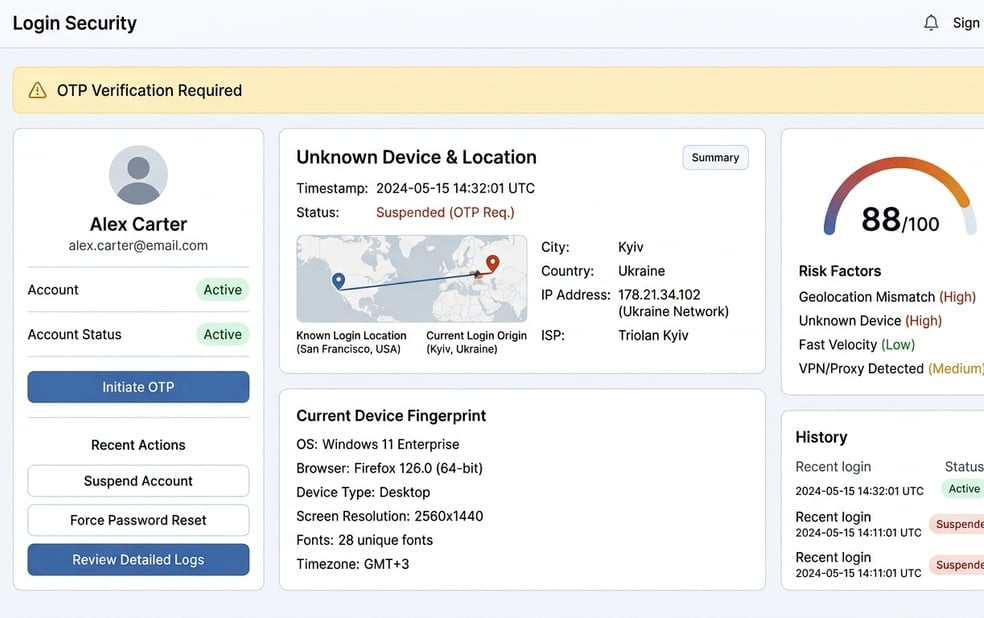
Account takeover prevention dashboard showing a flagged suspicious login
98.4%
ATO sessions blocked

Account Takeover (ATO) Prevention

Detect when a legitimate user's credentials have been compromised. By correlating new device fingerprints, abnormal geolocations, and behavioral profile deviations, FraudSense AI blocks unauthorized sessions before funds can be moved. Suspicious logins are challenged with step up OTP verification.

New device plus unusual geoBehavioral baseline deviationFailed login velocity spike
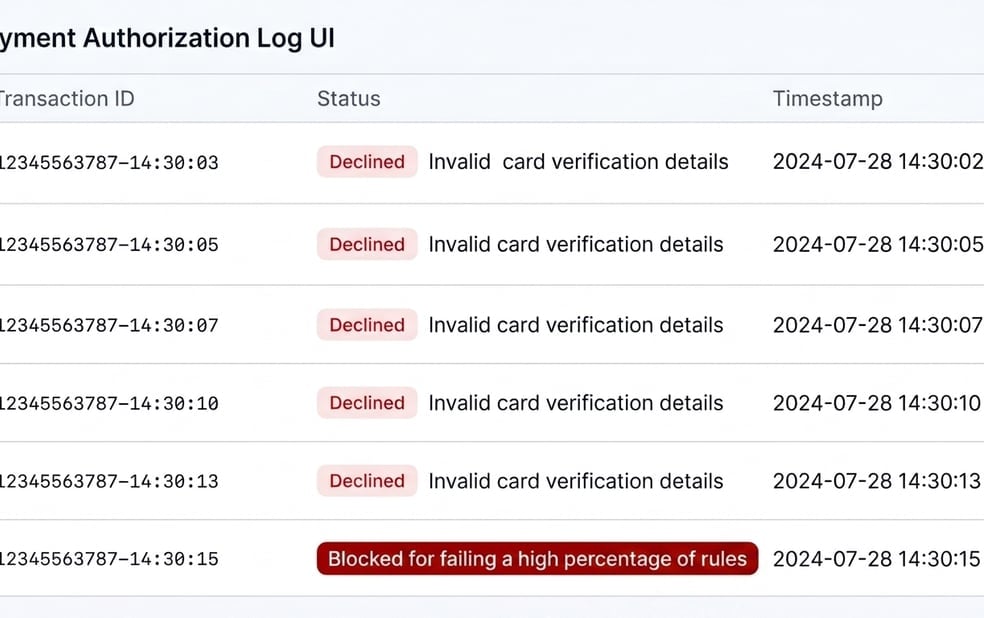
Card testing mitigation log showing rapid declined card attempts
< 50ms
Decision latency

Card Testing Mitigation

Shut down BIN attacks and card testing patterns in real time. Velocity signals such as transactions in the last five minutes and one hour, plus abnormal failed authorization rates, feed directly into the Rules Engine and detection ensemble. The system can decline or challenge automated card testing scripts instantly.

Five minute transaction velocityFailed authorization rateBIN pattern clustering
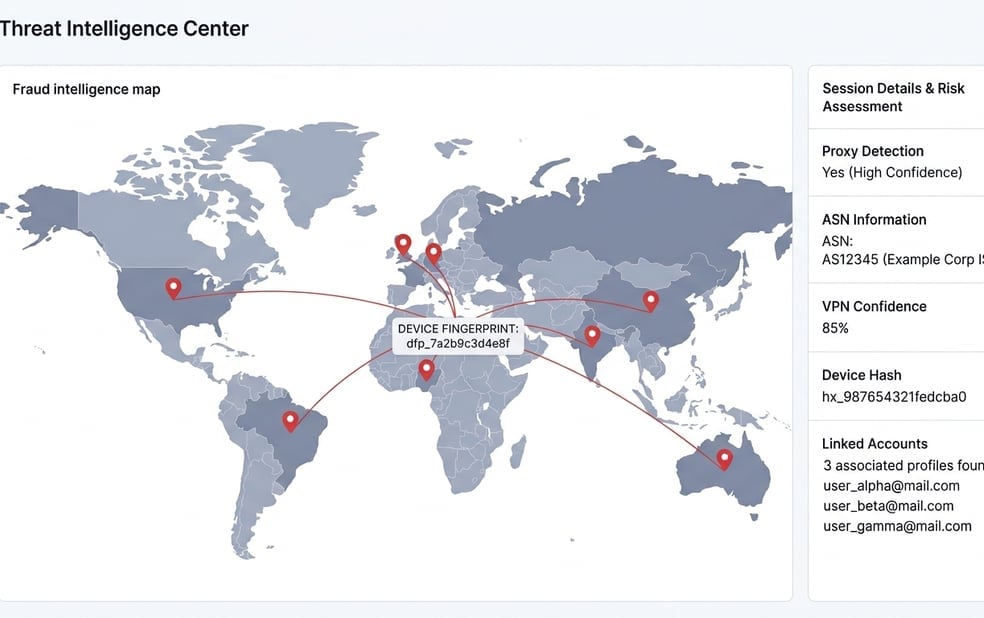
Botnet and proxy detection map showing device reuse across geographies
24/7
Continuous profiling

Botnet and Proxy Detection

Identify distributed fraud campaigns operating through proxies, VPNs, and device farms. Device hashing, IP reputation, and cross account correlation expose when a single physical device is being used across multiple stolen accounts, even when attackers rotate IP addresses.

Device hash reuse across accountsProxied or VPN IPDevice farm signatures

Request a demo

Request a demo with one of our product experts and find out if FraudSense AI meets your business needs.

During the demo process you'll touch on our:

  • API infrastructure and data integration capabilities
  • Modular design and flexible multi-tenant set up
  • No-code rule builder, AI feature library, and model explanations
  • Any further questions you may have

By submitting this form, you agree to our Privacy Policy.